
Why the future belongs to institutions that connect corporate banking, investment banking, and wealth management
By George Anderson | Ninth Wave
A founder sells her company for $200 million. Which division of the bank owns that relationship? Commercial Banking? Investment Banking? Private Wealth? Increasingly, the answer is all of them.
For decades, financial institutions have organized themselves around distinct business lines. Commercial banking served businesses. Investment banking advised on capital formation, mergers, acquisitions, and public offerings. Wealth management focused on helping individuals and families preserve and grow personal assets.
This organizational structure made sense from the institution’s perspective, but it no longer reflects how wealth is created.
Today, the most valuable client relationships span all three disciplines. Entrepreneurs launch companies using commercial banking services. Businesses grow through lending, treasury management, and capital formation. Investment banking supports acquisitions, recapitalizations, and eventual liquidity events. Wealth management helps founders, executives, and employees navigate the transition from enterprise value to personal wealth.
While financial institutions often treat these as separate businesses, clients experience them as one continuous financial journey. The next era of financial services will be defined not by the strength of any individual business line, but by how effectively institutions connect them.

The Wealth Creation Lifecycle
The traditional wealth management industry has largely focused on managing assets after wealth has already been created. Increasingly, however, leading financial institutions recognize that the competition for tomorrow’s wealth clients begins years earlier. It begins with helping companies build value.
Consider the lifecycle of a successful privately held business.
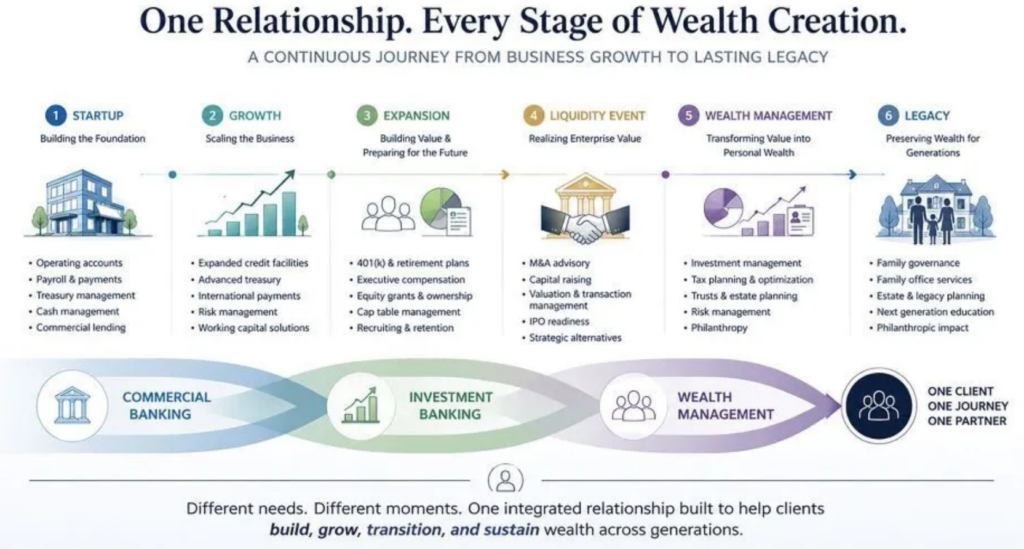
The relationship often starts with the basics, operating accounts, payroll accounts, payments, treasury management, commercial lending, and cash management. As the company grows, its financial needs become more sophisticated. Credit facilities expand and treasury operations become more complex. Payroll scales. International payments requirements emerge. Risk management becomes increasingly important. Soon, another layer develops.
The company establishes a 401(k) plan. Executive compensation programs evolve. Equity grants become part of the recruiting strategy. Cap tables grow more complex as new investors, option holders, and key employees acquire ownership interests.
Eventually, the company may pursue outside investment, strategic acquisitions, or prepare for an IPO or sale. Investment bankers enter the picture. Attorneys, accountants, valuation experts, and tax advisors become deeply involved.
A liquidity event is not merely a transaction. It is one of the largest balance-sheet transformations a person will experience. Overnight, an illiquid operating business becomes investable capital.
Finally, years of building enterprise value are transformed into personal wealth. What began as a commercial banking relationship now evolves into sophisticated private wealth management involving portfolio construction, tax planning, trusts, estate planning, philanthropy, family governance, and often a family office.
Viewed through the client’s eyes, this is not a collection of disconnected financial services. It is one continuous journey (see chart below).
Winning the Relationship Before the Liquidity Event
One of the most important shifts occurring across financial services is that institutions are increasingly competing to establish relationships long before wealth becomes investable. Historically, wealth managers focused on assets after an IPO, business sale, or inheritance.
Today’s leading firms recognize that by then, the relationship may already belong to someone else.
The competition for tomorrow’s wealth clients increasingly begins long before assets become investable. It starts when institutions help entrepreneurs build companies, employees accumulate equity, employers sponsor retirement plans, and founders prepare for the liquidity events that ultimately transform business value into personal wealth.
That philosophy helps explain many of the strategic investments being made across the industry.
Commercial banking, workplace financial services, equity compensation, retirement plans, investment banking, and private wealth are increasingly being viewed not as independent businesses, but as interconnected stages within a much larger client relationship.
The Workplace Has Become the New Front Door
This convergence extends well beyond founders and key employees.
Consider a 30-year-old software engineer joining a fast-growing technology company.
She enrolls in her employer’s 401(k), receives stock options, participates in workplace financial education, and begins building retirement savings while gradually accumulating equity ownership in the company.
Over time, additional option grants increase her ownership stake. She receives guidance on equity compensation, diversification strategies, and retirement planning. She develops trusted relationships with financial professionals long before her wealth becomes significant. Years later, the company is acquired or goes public.
Overnight, stock options that once seemed speculative become meaningful personal wealth. The institution managing that workplace relationship didn’t suddenly appear after the IPO. It earned the client’s trust over years of financial education, retirement planning, equity administration, and ongoing engagement.
The competition for tomorrow's wealth clients increasingly begins long before assets become investable.
Morgan Stanley didn’t win that relationship at the IPO. The IPO simply revealed a relationship that had already been developing for years.
The same principle applies to founders, executives, and early investors. The institutions that participate in the wealth creation process are often best positioned to guide clients through wealth preservation afterward.
Connecting the Corporate and Personal Balance Sheet
Founding teams face an even broader set of financial decisions.
Long before a business is sold, they rely on commercial banking relationships for operating accounts, treasury management, lending, and liquidity. They establish employee retirement plans, issue equity compensation, recruit executives, and often manage increasingly sophisticated ownership structures.
Platforms supporting cap table administration have become an important part of this ecosystem, not simply because they manage ownership records, but because they provide visibility into how enterprise value is being created and distributed across founders, executives, employees, and investors. As companies mature, those ownership structures become central to transaction planning.
Cap table platforms have quietly become one of the earliest indicators of future wealth creation. Years before an IPO or acquisition, they reveal ownership concentration, option grants, dilution, vesting schedules, and the distribution of enterprise value. They provide institutions with a window into where tomorrow’s wealth is being created, not after liquidity occurs, but while value is still being built.
Investment bankers evaluating strategic alternatives, tax professionals designing transaction structures, estate attorneys preparing wealth transfer strategies, and private wealth advisors planning post-transaction portfolios all depend upon understanding ownership, equity, and the timing of liquidity events.
Cap table platforms have quietly become one of the earliest indicators of future wealth creation.
The traditional boundaries between commercial banking, investment banking, and wealth management begin to disappear. Instead, institutions gain a connected view of the client’s financial life across both the corporate and personal balance sheet.
Technology Enables the Strategy It Doesn’t Define It
Artificial intelligence, open finance, embedded finance, and connected financial data are accelerating this convergence.
Advisors and bankers increasingly need secure access to information across commercial accounts, lending relationships, retirement plans, brokerage accounts, equity compensation, cap table systems, trusts, and external financial institutions. Without connected, permissioned data, advisors are forced to assemble fragmented information manually or rely upon clients to connect the dots themselves.
Artificial intelligence can identify opportunities, coordinate specialists, and surface insights across these historically separate businesses.
But AI is only as effective as the data available to it.
Trusted financial data, governed access, and connected client experiences will become foundational infrastructure supporting this new model of advice. Technology does not replace relationships.
It strengthens them.
A New Competitive Landscape
Financial institutions have spent decades organizing around products.
Clients have always organized around goals.
The institutions that win the next decade will not be those with the largest wealth management business or the strongest commercial bank.
They will be the institutions that recognize the client relationship begins long before wealth becomes investable and continues long after the transaction closes.
The future belongs to firms that can accompany entrepreneurs through the entire Wealth Creation Lifecycle, from the first operating account to the final transfer of wealth across generations.
George Anderson is the Founder of Ninth Wave.
Learn more at www.ninth-wave.com and LinkedIn.